Monday, November 13, 2017

Catherine Sforza, the Tigress of Forli, and Grandmother to Cosimo I, part 1


Another remarkable Renaissance woman was Catherine Sforza (1463-1509), who was raised in the Court of Milan and received a humanistic education alongside her brothers.  She learned to take pride in the histories of her warrior ancestors, and to show boldness in the use of arms and military maneuvers. 

She was married at the age of ten to Girolamo Riario, but the marriage was likely not consummated until she reached the "legal age" of 14.  Girolamo was the nephew of Pope Sixtus IV, and the young couple lived in Rome in service of the pope.  Catherine gave birth to the first of many children at the age of 15.  However, the  lives of Girolamo and Catherine were to change abruptly upon the death of Sixtus IV on August 12, 1484.

As was the custom at the time, upon the death of the pope, the city of Rome erupted into chaos.  The Palazzo Orsini, in the Campo di Fiori, where Girolamo and Catherine had been living, was stormed and stripped of its furnishings.  Catherine, on behalf of her husband (and seven months pregnant at the time), rode on horseback across the Tiber, and took possession of the rocca (fortress) of Castel Sant' Angelo, and effectively prevented the conclave from forming, as the cardinals were afraid for their lives.

Caterina remained in control of Castel Sant' Angelo for almost two and a half months, sometimes in opposition to her husband.  Finally, she was persuaded to abandon her post by the enticement of 8000 ducats and the reinstatement of ownership of Forli and Imola, which had been granted Girolamo Riario when his uncle was pope.

I first encountered Caterina Sforza in the excellent book, The Tigress of Forli, by Elizabeth Lev.  Recently, I watched The Borgias (a Showtime series with mixed reviews), where the part of Caterina Sforza was played by Gina McKee, a talented English actress.  The portrait above is by Lorenzo di Credi; it hangs in the Pinoteca of Forli.


Saturday, July 30, 2016

Another Influential Renaissance Woman, Alexandra Strozzi


This building, the Strozzi Palace in Florence, is getting ready to open in September a special exhibition to feature the works of Ai Wei-Wei, the Chinese activist/artist.  From "The Florentine," the English language newspaper we have this announcement:

"Flagship installation Reframe will consist of 22 large rubber inflatable lifeboats attached to the windows of Palazzo Strozzi's facade.  This powerful comment on the desperate plight of refugees who risk their lives to reach Europe by crossing the Mediterranean is representative of the overall theme of the exhibition:  the artist hopes to raise awareness about our contemporary international humanitarian crisis."

This magnificent palazzo might never have come about had it not been for the tireless activities of Alexandra Strozzi, the mother of the actual builder, Filippo Strozzi.  Alexandra married Matteo Strozzi in 1422.  They had eight children together, of whom five survived into adulthood.  Matteo was exiled from Florence in 1434 when the Medici came back to consolidate their power and Matteo died a year later in Pesaro, likely of the plague.

Alexandra then returned to Florence and began a lengthy career of her own, that of managing the family's property interests.  She oversaw the work of the tenant farmers, collected rents, and paid the taxes.  She had no male relatives of her own; her father-in-law was already gone and Matteo's other male relatives had voluntarily chosen exile in 1434.

Eventually Alexandra's sons had to be sent away also; because their father had been a legal exile, their prospects were not considered very good.  The sons, especially Filippo, learned the banking and cloth merchant business with their first cousins in Naples, eventually amassing an even greater fortune than they.

The sentence of exile was finally lifted from Filippo (and his brother Lorenzo) in 1466, and he returned to Florence, where he began to acquire the many properties needed to assemble the site for his greatest undertaking, the Palazzo Strozzi.

We know of this remarkable story because Alexandra wrote letters to her sons while they were in exile.   She was an acute observer of the political and social life in Florence in the mid 15th Century, and she was determined to preserve their property and prestige despite their adverse circumstances.

"Selected Letters of Alexandra Strozzi," bilingual edition, was translated by Heather Gregory, who has helpfully provided us with and introduction and notes.  It's available through the University of California Press.


Sunday, July 3, 2016

Beatrice d' Este, sister of Isabella, and later Duchess of Milan


Beatrice d'Este (1475-1497) was the younger daughter of Ercole d` Este and Eleanora di Aragon (see post of 12/26/15), and grew up first in the court of Naples.  Only as a young teenager was she allowed to come to the court in Ferrara.

She was engaged at the age of 15 to Ludovico Sforza (il "Moro" for his dark looks), Duke of Bari at the time, and married to him a year later. 

Beatrice had the same excellent education as her male sibling and cousins (rare at the time), and proved herself excellent at diplomacy.  In 1492, as ambassador for her husband, she visited the Republic of Venice, where her primary mission was to advance her husband's scheme to become the Duke of Milan.  

This was accomplished in 1495 when il Moro usurped the role, on the somewhat mysterious death of Gian Galeazzo Sforza.  Taking advantage of her position in the wealthy court of Milan, Beatrice gathered around her the leading artists, writers, and courtiers of the day, including Niccolo` di Correggio and Leonardo di Vinci, among many others.

Sadly, Beatrice died after the birth of her third child, at the young age of 21.  She lived a short but glorious life, at the height of the Renaissance.  Had she lived on, she might not have thought her life so charmed, as her husband lost power and ended up spending his final years in the underground dungeon of a French castle.

One of my favorite books about Beatrice is "The Duchess of Milan," by Michael Ennis, published in 1992.  While Ennis does not give a bibliography (it is after all, a work of fiction), I have found no factual errors.  Ennis earned a degree in history at UC Berkeley, so perhaps that accounts for the accuracy of details.

As a reviewer on Amazon says, it is a rich book, and worth reading and re-reading (which I have done).  Highly recommended.


Saturday, April 23, 2016

Isabella d' Este, Another Influential Renaissance Woman


After seeing Titian's portrait of her (above), Isabella famously said it was "so pleasing that I doubt that at the age I am represented I could have possessed all the beauty it contains."  In reality, she was in her sixties at the time, and had given Titian instruction to portray herself as a much younger woman.  This portrait now hangs in a museum in Vienna.

Isabella, born in 1474, was the daughter of Eleanora of Aragon d'Este, Duchess of Ferrara (see post of 12/26/15) and Ercole I d'Este, Duke of Ferrara. Her parents educated their daughters and sons equally (very unusual at the time).  Isabella and her sister Beatrice both studied Latin and Greek, Roman history, music and dancing.  

When Isabella was six, she was betrothed to the future fourth Marquis of Mantua, Francisco Gonzaga, and married him in 1490.   Her younger sister, Beatrice, married the Duke of Milan, and the sisters visited each other often.  Isabella is best remembered for her role as patron of Renaissance learning, arts and literature.  Over two thousand of her letters have survived, and are a valuable resource for art historians.

When I visited Mantua last year, I was somewhat surprised to see how little acknowledgement she is given in her own home town.
At the Palazzo Ducale, we visited the Camera degli Sposi, where the frescoes--done by Mantegna and his shop--were in quite good condition, obviously restored.   The frescoes were done between 1465 and 1474, and I had to content myself with just imagining Isabella being in those rooms.  

The palazzo is huge--over 500 rooms--but only the few rooms around the Camera deli Sposi were open to visitors.  In my opinion, it's quite a shame that this national treasure is such a neglected resource.


Saturday, December 26, 2015

Meanwhile, and elsewhere in Italy, there were other interesting and influential Renaissance Women . . .


 . . . including Eleanora of Aragon d'Este, Duchess of Ferrara.  Daughter of Ferdinand I of Naples and Isabella of Clermont, Eleanora (1450-1493) was married first into the Sforza family and then, at age 23,  to Ercole I d'Este, duke of Ferrara.  She was known for her bravery and leadership skills, and in 1485 when Ercole's nephew Niccolo` attempted a coup d'etat, she escaped the besieged palace with her children Isabella, Beatrice, and Alfonso, who was only a few weeks old.

     Eleanora was also known for commissioning a number of artworks and building projects (see post of Jan 22, 2013), and as we shall see, for inspiring her daughters to become powerful women in their own rights.


     Recently I visited the Castello Estense in Ferrara, where I was gratified to see Eleanora remembered for the contributions she made to the Court.  She used her considerable dowry monies to refurbish not only her own apartments, connecting staircases and terraces, but also a hanging garden.  Through the years it was enlarged and eventually became the Garden of the Oranges, a tribute to her Neapolitan roots. (source, a placard in the Castello Estense)


Thursday, April 16, 2015

Cardinal Giovanni de' Medici


Giovanni took up residence in Rome in 1500, where he lived a lavish lifestyle, surrounded by friends and relatives, including his cousin Guilio, illegitimate son of the Guiliano who had been murdered by the Pazzi, and his youngest brother, also named Guiliano.  According to Christopher Hibbert, in "The House of the Medici," Giovanni played the role of the generous host to the extent that he was frequently in debt.  The days of the great Medici Bank, established by Giovanni's great-great-grandfather were over.  Church benefices and later, the sale of indulgences, would fund the lives of the Medici cardinals and popes.

In 1503 a new pope was elected:  Cardinal Guilano della Rovere became Julius II.  Known as the "Warrior Pope" for expanding the Papal States by warfare, he was also known for his ambitious building projects and his patronage of the arts.  Julius II commissioned the destruction and reconstruction of St. Peter's Basilica, and also later commissioned the decoration by Michelangelo of the ceiling of the Sistine Chapel.

The cardinals, including Giovanni, accompanied Julius II in battle, aided by the Spanish, and as it happened, Giovanni was taken prisoner near Bologna by the French in 1512, but later escaped and made his way to Mantua.  There a plot was in the works to bring the Medici back to power in Florence, which had been suffering a lack of leadership after the exile of the Medici.   The Spanish Army then marched on into Tuscany, where the engagement that was later called "The Sack of Prato" convinced the Florentines to lay down arms.   The Medici Family was now back in power in Florence!!


Sunday, April 5, 2015

The Legacy of Lorenzo and Clarice


Why not have it all?  Control of both Church and State!  Although this may have been their plan, control of both Church and State at the same time would prove difficult for the Medici Family.

After Lorenzo's death, the head of the family was Piero, the eldest son.  Unfortunately, he was not the diplomat his father was.  In brief, he allowed the French king to march his army through Florence in 1494, after which the Florentines exiled the Medici.

The hopes of the family were then pinned on the future of Giovanni 1475-1521), second son of Lorenzo and Clarice.  From an early age, he had been destined for the Church.  He was tonsured at age seven or eight and made a cardinal at the age of 13.  He was not allowed to wear the robes until three years later, but as his father lay dying in Florence in 1492 he was already being welcomed in Rome (see Lives of the Early Medici, as told by their correspondence, translated by Janet Ross).

After being exiled from Florence, because there was a price on his head, Giovanni traveled in Germany, the Netherlands and France, returning to Rome in 1500, where he was welcomed by the Borgia Pope, Alexander VI.

The fresco above, Ghirlandaio's "Confirmation of the Franciscan Rule," in the Sassetti Chapel of Santa Trinita in Florence, is widely believed to be portraits of the young children of Lorenzo and Clarice.  According to "The Medici, the Golden Age of Collecting," by Massimo Winspeare, proceeding up the staircase is the children's tutor, Agnolo Poliziano, with Guilio (son of the murdered Guiliano, see post of 9/23/12) followed by Piero and Giovanni.  Bringing up the rear are the poet Luigi Pulci and the canon Matteo Franco.  Hint:  there are two future Medici popes in this fresco!


Friday, March 6, 2015

And then Lorenzo died . . .


. . . at his villa at Careggi on April 9, 1492.  He was 43 years old, and had been suffering from the same disease that had affected many other members of the family, gout.  He had taken the last sacrament already, but according to some accounts, called for Fr. Savanarola, who had repeatedly preached against the power and might of the Medici, to hear his confession.

     Of course, we will never know if Lorenzo actually confessed to the sin of misappropriating state and trust funds, specifically the Monte di Doti, but the evidence seems to indicate that near the end of his life, Lorenzo did line his own pockets through a scheme of reducing the interest paid (see Alfred von Raumont's account in Lorenzo De' Medici:  the Magnificent, Volume 2).

     Lorenzo's "dark side" is symbolized for me by the above image, the reverse of the Desco da Porto (birth tray, see blog entry of 2/14/12), which was once resplendent in silver decoration that has now oxidized, and which is embellished with Piero de' Medici's emblem, a diamond ring, three feathers, and a banderole inscribed with the motto "Semper" or "Always."  The birth tray was hanging on the wall of Lorenzo's bedroom at Careggi, and was included in the inventory done at his death.  These inventories, while done at the time for tax purposes, have served history well in that we have  documentation from the time and place.

Saturday, September 6, 2014

Another Orsini Marries into the Medici Family, 1488


Lorenzo di Medici and Clarice Orsini had ten children, including their oldest son, Piero de Lorenzo de Medici, called "the Unfortunate," because of the events he allowed to unfold after his father's death.

But that is skipping ahead of the date, 1488, when Piero married Alfonsina Orsini, who was 16 at the time, and the daughter of Roberto Orsini, Conte Tagliacozzo, and Catherine San Severino.   While Piero may be called "the Unfortunate," it was a fortunate  marriage for the Medici family (and the city of Florence) because decades later  Alfonsina would serve as Regent.

The portrait above, by Botticelli, is currently in the inventory of the Palazzo Pitti.  To my knowledge it has not been on display in recent years.  But just as there is renewed interest in Anna Luisa de Medici (and that's skipping centuries ahead) currently, perhaps there will come a time when some curator decides to do an exhibition on the Medici wives.


Thursday, May 22, 2014

Lorenzo's Last Mistress


Francesco Guicciardini said that when he was forty Lorenzo who 'was licentious and very amorous,' fell desperately in love with Bartolommea dei Nasi, the wife of Donato Benci, and spent night after night with her at her country villa, returning to Florence just before dawn.  "Although she was not shapely, she was courteous and well-mannered."

Guicciardini further comments, "It is absurd to consider so important a man, with his reputation and judiciousness should, at the age of forty, be so taken with a woman who was not beautiful and already advanced in years."  Bartolommea was thirty at the time.

While the above portrait is not Bartolommea (it's Portrait of a Woman Inspired by Lucretia, by Lorenzo Lotto, c. 1553), I'd like to think that she might have looked something like this, beautiful in spite of her size and years.  


"Guicciardini gave credence to the report that the fatal illness of Lorenzo was brought on by the exposure to which Lorenzo subjected himself in following up his love intrigue with Bartolommea de' Nasi, the wife of Donato Benci, a lady who was neither young nor beautiful but of much distinction in manner and intelligence.  In order to save the reputation of the lady, who lived near her villa in the country during the winter months, Lorenzo, then a widower, visited her regularly after nightfall and returned to Florence in the morning.  He was accompanied on these occasions by a portion of that body-guard, with some of whom he was always surrounded after the conspiracy of the Pazzi.  Two of them having complained of their hard service, the lady contrived o get them sent away in disgrace on distant embassies.  'A mad thing'..., says Guicciardini, 'was it, if we consider that a man of such greatness, reputation, and prudence---of forty years of age---should e so captivated by a lady, not beautiful and full of years, as to be brought to do things which would have misbecome any boy.'"  (Smith, 1876, p. 134)

Monday, February 24, 2014

And then Clarice died . . .


. . . of tuberculosis, at the age of only 34, on July 30, 1488.  Her grieving husband Lorenzo wrote the following to Pope Innocent VIII:

Sanctissime ac Beatissime Pater post Pedum oscula Beatorum Vestrorum

Too often am I obliged to trouble and worry Your Beatitude with accidents sent by fortune and divine interposition, which as they are not to be resisted must be borne with patience.  But the death of Clarice, which has just occurred, my most dear and beloved wife, has been and is so prejudicial, so great a loss, and such a grief to me for many reasons, that it has exhausted my patience and my power of enduring anguish, and the persecution of fortune, which I did not think would have made me suffer thus.  The deprivation of such habitual and such sweet company has filled my cup and has made me so miserable that I can find no peace.  Nought is left but to pray God that He may give me peace, and I have faith that in His infinite love He will alleviate my sorrow and not overwhelm me with so many disasters as I have endured during these last year.  I humbly beg your Beatitude with all my heart to pray for me as I know how efficacious are such prayers.  I commend myself and place myself at Your Holy Feet.----Filetta, July 31, 1488.  Your devoted servant, Laurentius de Medicis.

I've posted a view of the interior of the Basilica of San Lorenzo, the Medici family church.  There's no mention that I can find of whether or not Clarice is buried in either the Old Sacristry or the New Sacristry, but I would like to think that at least there was a service for her in this beautiful church, designed by Brunelleschi.

Friday, November 29, 2013

Maddelena, Lorenzo's favorite daughter


"Historians believe Maddalena de’ Medici, born in Florence on 25 July 1473, was Lorenzo il Magnifico’s favourite daughter. Her marriage to Franceschetto Cybo, the son of Pope Innocent VIII, was a vitally important development for this noble Florentine house. Lorenzo’s prestige grew and, furthermore, he was able to better cultivate his relations with the Pope. This marriage also paved the way for his second son, Giovanni, who was to assume the papal office as Leo X. Maddalena received this work, a small exquisitely adorned and bound book of prayers − now a part of the Rothschild   collection at Waddesdon Manor in England − as a wedding gift. (see post of Aug 24, 2013)  Of the codices commissioned for his daughters, this work was the finest and most richly adorned. The original binding went missing hundreds of years ago. Franco Cosimo Panini Editore therefore conducted in-depth historical and philological research to do the impossible: painstakingly reconstruct the binding as it was, down to the very last detail! An extraordinary tribute to Maddalena de’ Medici has thus been revived." (from http://www.oremedici.it/en/the-manuscript/

Saturday, August 24, 2013

Lorenzo had these Books of Hours made . . .


. . . for his three daughters as wedding gifts.  'The first of these works - commissioned about 1485, and now to be found in Monaco - he gave to Lucrezia, who married Jacopo Salviati.  The second, now at the Biblioteca Medicea Laurenziana library, was for Luisa, the betrothed of Giovanni di Pierfanncesco de' Medici (she died before the day of the wedding).  The third was a wedding gift for Maddalena, the bride of Count Franceschetto Cybo, the illegitimate son of Pope Innocent VIII.  These three Offizioli (or breviaries) are a touching tribute from a loving father - one of the most powerful men of the period of the Renaissance - to his three very young daughters."(from  http://www.oremedici.it/en/the-manuscript).


Sunday, June 23, 2013

Another Botticelli Beauty--Minerva and the Centaur


As I mentioned in the last post (March 21, 2013--sorry for the gap), Lorenzo traveled to Naples to convince King Ferdinand "that a large and potent pontifical state would irremediably alter the already fragile equilibrium amount Italian states." (The Medici, Story of a European Dynasty,by Franco Cesati).

Botticelli's "Minerva and the Centaur," commissioned around 1485 by/for a minor branch of the Medici family, has been interpreted as an allegory of Lorenzo's success with King Ferdinand.   Not coincidentally, the Gulf of Naples can be made out in the background, while the goddess's cloak is studded with the three interlocking Medicean rings.  (Source:  The Medici, by Cesati)

This painting is in the Uffizi, where it is listed as "Pallas and the Centaur."

For an interesting read on the significance of the Roman goddess Minerva (also known as the Greek goddess Pallas Athena) go to this web-site:  http://library.thinkquest.org/17709/people/athena.htm.  For further reading, and other interpretations, visit this web-site:  http://www.palazzo-medici.it/mediateca/en/Scheda_Sandro_Botticelli,_Pallade_e_il_centauro_(1482-1485_circa)

Thursday, March 21, 2013

"The Botticelli Secret" . . .


. . . a novel written by Marina Fioroto, is a story about "secrets" embedded in Botticelli's famous painting.  The painting tells, in allegory, the story of a sinister high-level conspiracy among the rulers of the Italian city-states at the end of the 15th century.  A fascinating book on many levels, and one I can't wait to re-read.  It's sitting in my "library" in Florence, and I will re-visit it soon.

In the years following the Pazzi Conspiracy, there was a fragile peace established amongst the major Italian city-states, which were Florence, Venice, Milan, Naples and Rome.  Much of Lorenzo's time and attention was spent keeping the powers balanced.  He even traveled to Naples to negotiate with King Ferdinand directly, knowing full well that at any time the King could have turned him over to his enemy the Pope, had the King been so inclined.

In any event, today is an appropriate day to contemplate "The Primavera," or "Spring."

Sunday, January 27, 2013

In the meanwhile, Sandro Botticelli . . .


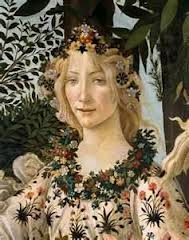
. . . was painting the "Primavera," which today hangs in the Uffizi.  The patronage and meaning of the painting are shrouded in mystery and speculation.  It most likely was commissioned by one of the Medici, perhaps Lorenzo himself, or by his cousin, Lorenzo di Pierfrancesco de Medici.  Whatever its origin and history, by 1499 it was included in an inventory of the possessions of Lorenzo di Pierfrancesco.

     There are many fascinating aspects to the painting, including that there are around 500 different plant species, of which 130 have been specifically named, according to Gloria Fossi, in her 1998 book.

     The painting has been in the Uffizi since 1919, except during WWII when it was removed to a castle about ten miles south of Florence, to protect it from war time bombing.

     The painting has darkened considerably just since I have been going to visit it.  In 2002, when I first saw it,  the colors were quite brilliant.  Sadly, these days I skip the Botticelli rooms altogether, as it breaks my heart to see how dark and dingy so many of the paintings have become.  According to my research, the last time this painting was restored was 1982.  Unfortunately, it needs to be done again.  The next time I am in the office of Amici deli Uffizi (to buy my museum pass), I will ask if there are any plans.

Tuesday, January 22, 2013

Who were the Duke and Duchess of Ferrara?


So, who were the Duke and Duchess of Ferrara, so important that Lorenzo would write to each, individually, immediately after the death of his beloved mother Lucrezia?  And where is Ferrara?

Ferrera, in the province of Emilia-Romagna, today is a one hour train ride north from Florence.  It's a well preserved walled medieval city, with many 15th and 16th century palazzos, as well as a Romanesque cathedral (pictured above).

Back in Lorenzo's day, the Duke of Ferrara, Ercole I d'Este, was an important ally during the Pazzi War (the aftermath to the Conspiracy).

"The Duchess of Ferrara, Eleanora d'Aragona, has a special place in the history of patronage in the Renaissance period because of the notable amount, quality, and innovative subject matter of the works she sponsored.  She came to Ferrara from Naples in 1473 at the time of her marriage to the Ferrarese ruler, Duke Ercole I d'Este, and became an important sponsor of art and architecture in the city of the Este family until her death in 1493.  Most other wives of courtly rulers in the fifteenth century were less active in their art patronage.  Eleanora was notable for the scale and diversity of the artworks produced specifically for her during her reign, works that included significant building projects in the city of Ferrara, fine illuminated manuscripts, mural painting, and pictures on panel."  (from Joseph Manca's article on "Isabella's Mother:  Aspects of the Art Patronage of Eleanora d'Aragona, Duchess of Ferrara, in The Journal of the History of Art)


Wednesday, January 9, 2013

The Death of Lucrezia in 1482 . . .


Lorenzo de' Medici to the Duchess Eleanora d'Aragona d'Este at Ferrara:

"The duty I owe Your Excellency compels me to communicate to you the terrible and disastrous blow that has today befallen me through the death of my most beloved mother Madonna Lucrezia.  This leaves me utterly desolate as Your Excellency can think, for I have lost, not only a mother, but the only person I could turn to in many vexations and who aided me in many troubles.  It is true that we ought to submit patiently to the will of God, but in this case my heart refuses to be comforted.  I pray He may perhaps send me patience and comfort, and grant her peace and happiness.  Your excellency to whom I thus pour out my grief for such a loss, and to whom I turn for comfort in such sorrow, will understand the state in which your attached servant, who commends himself to you with all his heart, finds himself,  Florence, March 25, 1482."                                                     Your Excellency’s Servant, Laurentius de Medicis


 . . . and to Duke Ercole D’Este, Lorenzo wrote much the same letter, adding, “I am more full of sorrow than I can say, as besides losing a mother, at the mere thought of whom my heart breaks, I have lost the counsellor who took many a burden from off me.”


The text is from Jane Ross's translation of the Lives of the Early Medici, as Told in Their Correspondence, published in 1910.

The book cover is a recently published book, which I am lusting after . . . perhaps I can get my local library to order it, if they haven't already.

Sunday, December 9, 2012

The Pazzi Conspiracy: A Tour through Florence

Now, with a nod to Cheryl Tucker, whose concept for this walk was first published In Florence, Sights and Landmarks:


Let us begin at the Palazzo Medici Riccardi (see post of Sun, Jan 29, 2012), at the corner of Via Cavour and Via de' Gori. The conspirators had originally set their sights on this palace to carry out their attack on the two Medici brothers, but as Guiliano was not in attendance, the site was changed to the duomo, one long block away, down Via de Martelli:


We'll walk around the north side of the cathedral, taking note of the fact that Lorenzo hid in the North Sacristry until it was safe to get back to the Palazzo Medici-Riccardi (see post of Feb 3, 2012 for more info on the duomo).  We'll proceed to the street facing the east side of the cathedral,  the Via del Proconsolo, and we'll turn south, going about a block to the corner where Borgo degli Albizi meets Via del Corso.  This is the Canto dei Pazzi (see post of Nov 25, 2012), where the Pazzi and their compatriots would have run from the melee that ensued after the murder of Guilano and the attempt on the life of Lorenzo.


Looking up we can see the Pazzi coat of arms (see post of Sep 28, 2012), and on the ground level we can take note of the entrance to the Palazzo Pazzi Quaratesi.  If we had been here Sep 21 & 22, 2012 and if we had purchased a 15 euro "wine card," as part of the Wine town 2012 festivities, we would have been able to enter (see <www.winetown.it> for details).  Since we missed that opportunity, we'll continue south along Proconsolo another long block or so until we see the Bargello.


Today the Bargello is the National Sculpture Museum, but in the time of the Medici it was a prison, and it was in this place that many of the low-level conspirators were hanged.  There will be more on the Bargello, one of my favorite museums, in a later post.   From here we cross the tiny Piazzi di San Firenze, turning right at Via di Gondi, which is also the most northeast corner of the Palazzo Vecchio.


Walking around to the front of the Palazzo, we see the windows at the top which served as a continuous gallows during those three days after the attempted coup.  The bodies of the major conspirators--Francisco de' Pazzi and the Archbishop of Pisa among them--were each left dangling by a noose above the crowd below (see post of Oct 20, 2012).  In all, about a hundred people were killed in three days.

I don't know about you, but one of the things that impresses me most about Florence is its permanence. Living in Southern California as I do most of the year, I have become accustomed to public, commercial, and private buildings being continuously torn down and replaced.  It gives me great reassurance to walk around Florence and see that the major landmarks are still there, as they were three, four, five hundred years ago.

Sunday, November 25, 2012

Canto dei Pazzi


Another reminder of the Pazzi family that we can still see today is the Palazzo Pazzi Quaratesi, or the Pazzi Quarter (neighborhood).  Today, when we walk north up Via del Proconsolo and turn left at Borgo degli Albizi to go to the Duomo, we look up and see "Canto die Pazzi," which means the Pazzi corner.  There we find the main Palazzo Pazzi, which was rebuilt 1462-72 for Jacapo de' Pazzi.  When the Pazzi were executed or exhaled, this property was seized by Lorenzo.  We next hear of it when it becomes a wedding present . . .
Also in the neighborhood is the three-story Palazzo Pazzi-Ammannati, which today houses Florence's small museum of natural history and is also the site of temporary exhibitions.


[edit]