Saturday, September 6, 2014

Another Orsini Marries into the Medici Family, 1488


Lorenzo di Medici and Clarice Orsini had ten children, including their oldest son, Piero de Lorenzo de Medici, called "the Unfortunate," because of the events he allowed to unfold after his father's death.

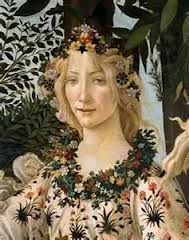
But that is skipping ahead of the date, 1488, when Piero married Alfonsina Orsini, who was 16 at the time, and the daughter of Roberto Orsini, Conte Tagliacozzo, and Catherine San Severino.   While Piero may be called "the Unfortunate," it was a fortunate  marriage for the Medici family (and the city of Florence) because decades later  Alfonsina would serve as Regent.

The portrait above, by Botticelli, is currently in the inventory of the Palazzo Pitti.  To my knowledge it has not been on display in recent years.  But just as there is renewed interest in Anna Luisa de Medici (and that's skipping centuries ahead) currently, perhaps there will come a time when some curator decides to do an exhibition on the Medici wives.


Thursday, May 22, 2014

Lorenzo's Last Mistress


Francesco Guicciardini said that when he was forty Lorenzo who 'was licentious and very amorous,' fell desperately in love with Bartolommea dei Nasi, the wife of Donato Benci, and spent night after night with her at her country villa, returning to Florence just before dawn.  "Although she was not shapely, she was courteous and well-mannered."

Guicciardini further comments, "It is absurd to consider so important a man, with his reputation and judiciousness should, at the age of forty, be so taken with a woman who was not beautiful and already advanced in years."  Bartolommea was thirty at the time.

While the above portrait is not Bartolommea (it's Portrait of a Woman Inspired by Lucretia, by Lorenzo Lotto, c. 1553), I'd like to think that she might have looked something like this, beautiful in spite of her size and years.  


"Guicciardini gave credence to the report that the fatal illness of Lorenzo was brought on by the exposure to which Lorenzo subjected himself in following up his love intrigue with Bartolommea de' Nasi, the wife of Donato Benci, a lady who was neither young nor beautiful but of much distinction in manner and intelligence.  In order to save the reputation of the lady, who lived near her villa in the country during the winter months, Lorenzo, then a widower, visited her regularly after nightfall and returned to Florence in the morning.  He was accompanied on these occasions by a portion of that body-guard, with some of whom he was always surrounded after the conspiracy of the Pazzi.  Two of them having complained of their hard service, the lady contrived o get them sent away in disgrace on distant embassies.  'A mad thing'..., says Guicciardini, 'was it, if we consider that a man of such greatness, reputation, and prudence---of forty years of age---should e so captivated by a lady, not beautiful and full of years, as to be brought to do things which would have misbecome any boy.'"  (Smith, 1876, p. 134)

Monday, February 24, 2014

And then Clarice died . . .


. . . of tuberculosis, at the age of only 34, on July 30, 1488.  Her grieving husband Lorenzo wrote the following to Pope Innocent VIII:

Sanctissime ac Beatissime Pater post Pedum oscula Beatorum Vestrorum

Too often am I obliged to trouble and worry Your Beatitude with accidents sent by fortune and divine interposition, which as they are not to be resisted must be borne with patience.  But the death of Clarice, which has just occurred, my most dear and beloved wife, has been and is so prejudicial, so great a loss, and such a grief to me for many reasons, that it has exhausted my patience and my power of enduring anguish, and the persecution of fortune, which I did not think would have made me suffer thus.  The deprivation of such habitual and such sweet company has filled my cup and has made me so miserable that I can find no peace.  Nought is left but to pray God that He may give me peace, and I have faith that in His infinite love He will alleviate my sorrow and not overwhelm me with so many disasters as I have endured during these last year.  I humbly beg your Beatitude with all my heart to pray for me as I know how efficacious are such prayers.  I commend myself and place myself at Your Holy Feet.----Filetta, July 31, 1488.  Your devoted servant, Laurentius de Medicis.

I've posted a view of the interior of the Basilica of San Lorenzo, the Medici family church.  There's no mention that I can find of whether or not Clarice is buried in either the Old Sacristry or the New Sacristry, but I would like to think that at least there was a service for her in this beautiful church, designed by Brunelleschi.

Friday, November 29, 2013

Maddelena, Lorenzo's favorite daughter


"Historians believe Maddalena de’ Medici, born in Florence on 25 July 1473, was Lorenzo il Magnifico’s favourite daughter. Her marriage to Franceschetto Cybo, the son of Pope Innocent VIII, was a vitally important development for this noble Florentine house. Lorenzo’s prestige grew and, furthermore, he was able to better cultivate his relations with the Pope. This marriage also paved the way for his second son, Giovanni, who was to assume the papal office as Leo X. Maddalena received this work, a small exquisitely adorned and bound book of prayers − now a part of the Rothschild   collection at Waddesdon Manor in England − as a wedding gift. (see post of Aug 24, 2013)  Of the codices commissioned for his daughters, this work was the finest and most richly adorned. The original binding went missing hundreds of years ago. Franco Cosimo Panini Editore therefore conducted in-depth historical and philological research to do the impossible: painstakingly reconstruct the binding as it was, down to the very last detail! An extraordinary tribute to Maddalena de’ Medici has thus been revived." (from http://www.oremedici.it/en/the-manuscript/

Saturday, August 24, 2013

Lorenzo had these Books of Hours made . . .


. . . for his three daughters as wedding gifts.  'The first of these works - commissioned about 1485, and now to be found in Monaco - he gave to Lucrezia, who married Jacopo Salviati.  The second, now at the Biblioteca Medicea Laurenziana library, was for Luisa, the betrothed of Giovanni di Pierfanncesco de' Medici (she died before the day of the wedding).  The third was a wedding gift for Maddalena, the bride of Count Franceschetto Cybo, the illegitimate son of Pope Innocent VIII.  These three Offizioli (or breviaries) are a touching tribute from a loving father - one of the most powerful men of the period of the Renaissance - to his three very young daughters."(from  http://www.oremedici.it/en/the-manuscript).


Sunday, June 23, 2013

Another Botticelli Beauty--Minerva and the Centaur


As I mentioned in the last post (March 21, 2013--sorry for the gap), Lorenzo traveled to Naples to convince King Ferdinand "that a large and potent pontifical state would irremediably alter the already fragile equilibrium amount Italian states." (The Medici, Story of a European Dynasty,by Franco Cesati).

Botticelli's "Minerva and the Centaur," commissioned around 1485 by/for a minor branch of the Medici family, has been interpreted as an allegory of Lorenzo's success with King Ferdinand.   Not coincidentally, the Gulf of Naples can be made out in the background, while the goddess's cloak is studded with the three interlocking Medicean rings.  (Source:  The Medici, by Cesati)

This painting is in the Uffizi, where it is listed as "Pallas and the Centaur."

For an interesting read on the significance of the Roman goddess Minerva (also known as the Greek goddess Pallas Athena) go to this web-site:  http://library.thinkquest.org/17709/people/athena.htm.  For further reading, and other interpretations, visit this web-site:  http://www.palazzo-medici.it/mediateca/en/Scheda_Sandro_Botticelli,_Pallade_e_il_centauro_(1482-1485_circa)

Thursday, March 21, 2013

"The Botticelli Secret" . . .


. . . a novel written by Marina Fioroto, is a story about "secrets" embedded in Botticelli's famous painting.  The painting tells, in allegory, the story of a sinister high-level conspiracy among the rulers of the Italian city-states at the end of the 15th century.  A fascinating book on many levels, and one I can't wait to re-read.  It's sitting in my "library" in Florence, and I will re-visit it soon.

In the years following the Pazzi Conspiracy, there was a fragile peace established amongst the major Italian city-states, which were Florence, Venice, Milan, Naples and Rome.  Much of Lorenzo's time and attention was spent keeping the powers balanced.  He even traveled to Naples to negotiate with King Ferdinand directly, knowing full well that at any time the King could have turned him over to his enemy the Pope, had the King been so inclined.

In any event, today is an appropriate day to contemplate "The Primavera," or "Spring."